Why we invested in Primitives: Transforming purple sea urchins into bio-materials to restore kelp forests
Mar 03, 2026
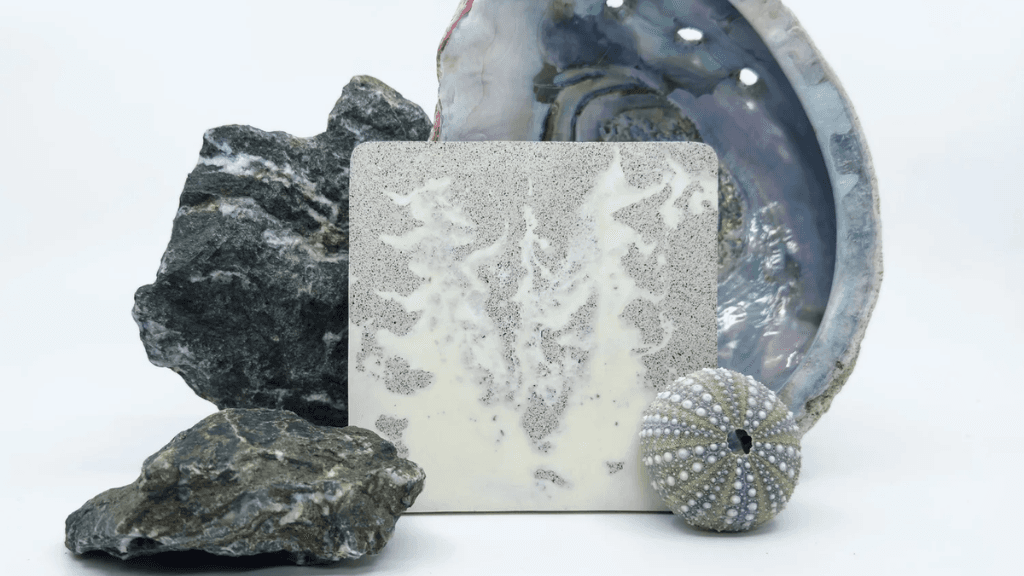
Urchinite™ is a biomarble engineered to support marine restoration and architectural design. Made from biocalcite, a naturally occurring marine mineral found in sea urchin shells, Urchinite is formed by integrating this mineral into a biobased binder, resulting in a durable, marble-like stone material sold as counter tops, wall tiles, furniture and other uses. (Photo credits: Primitives)
By: Alicia Hernández, SOA Investment Associate, and Matt Mulrennan, SOA Head of Investments.
From ecological collapse to scalable regeneration
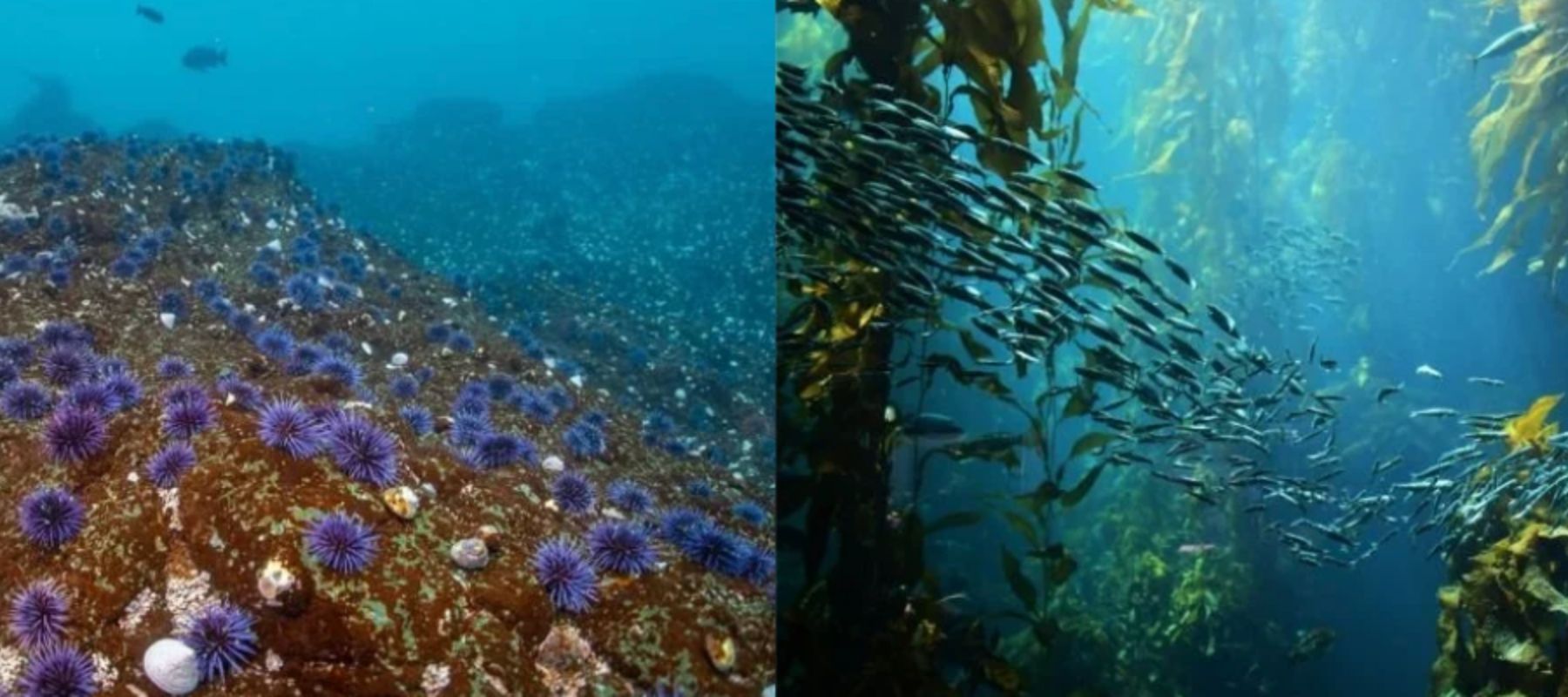
Across the West Coast, kelp forests have collapsed into vast “urchin barrens”: rocky seafloors carpeted by purple sea urchins where biodiverse underwater forests once thrived. As of 2023, in Northern California alone, more than 96% of kelp forests have disappeared. These losses matter. Kelp forests, often called the rainforests of the ocean, are among the most productive ecosystems on Earth, supporting thousands of species, underpinning fisheries, storing carbon, improving water quality, and buffering coastlines from storms.
At Sustainable Ocean Alliance (SOA), we invest in companies that tackle the root drivers of ocean ecosystem collapse while building pathways to scale. That’s why we’re proud to invest in Primitives, a Berkeley-based startup restoring kelp forests by removing overabundant sea urchins and transforming them into regenerative building materials. We are excited to join a strong group of supportive funders, including Savantus Ventures, Schmidt Marine Technology Partners, SOSV, and E14 Capital, alongside an exceptional group of advisors and research collaborators such as The Nature Conservancy.
Primitives’ model is built on a simple but powerful insight: ecosystem restoration and material production can be part of the same system. By transforming destructive sea urchins into architect-grade biomaterials, Primitives creates a direct economic engine for restoring kelp forests, aligning ecosystem recovery with scalable market demand.
The urgency behind this approach is ecological. It is a breakdown that traces back to the loss of a keystone predator. Turning some of the most richly biodiverse habitats into urchin barrens.
Beginning in 2013, a disease outbreak driven by Vibrio pectenicida killed an estimated six billion sunflower sea stars, nearly wiping out a keystone predator along the California coast. Without predation, purple sea urchin populations surged by as much as 10,000% between 2014 and 2022. In some areas today, nearly one urchin per square foot grazes relentlessly on young kelp (Eberle, 2026).
The result is a locked system. Even when ocean conditions are favorable, kelp cannot reestablish itself unless urchin grazing pressure is dramatically reduced, as they will eat the holdfast which is the structural base of the kelp that connects it to the rocks.
This is the bottleneck Primitives is built to address.
Restoration that starts with removing the pressure
Kelp restoration is not simply a planting problem. It is a grazing problem.
Primitives directly addresses this constraint by removing purple sea urchins at any size and condition from impacted reefs. Unlike traditional fisheries, which target large urchins for their premium roe (uni is the edible reproductive organ prized in sushi and fine dining), Primitives treats the entire organism as materials feedstock.
This enables large-scale removal that meaningfully reduces urchin density below ecological thresholds required for kelp recovery.
In practice, this means:
- Using any sized urchin clears rocky reefs of dense urchin fronts
- Allowing kelp forests to recover through natural succession
- Supporting the return of biodiversity, from invertebrates to fish and marine mammals
Primitives estimates that one Urchinite slab (5’ x 8’) corresponds to roughly 1,000 square feet of kelp forest restored, directly linking material production to ecological recovery.
As recently highlighted in The New York Times, a single countertop made from Primitives’ Urchinite could use up the urchins that would otherwise blanket a tennis-court-sized area of seafloor, illustrating the scale of impact embedded in each product.
Turning ecological liabilities into assets
Removing millions of pounds of sea urchins raises an immediate question: what do you do with the dead urchins?
Historically, this challenge has limited restoration scale and creates a logistical headache for restoration managers. Primitives flips this constraint into an advantage.
The company has developed a biomineral processing platform that converts overpopulated sea urchins into engineered biocomposites and biocalcite surfaces for architectural and interior design applications, including countertops, tiles, wall panels, and decorative surfaces.
This positions Primitives within a $420B+ global green building materials market growing at 12%+ CAGR, with a clear entry point into the $143B U.S. interior materials and $41.5B regional countertop segments. Demand is being further accelerated by wildfire rebuilding, housing mandates, and major infrastructure investments across California and the U.S.
At the same time a human health problem is unfolding, the dominant countertop material, engineered quartz, contains ~90% silica and its dust from cutting and construction has been linked to a deadly crisis among stone fabrication and installation workers, resulting in lawsuits. California has imposed strict safety measures, and Australia has moved to ban high-silica engineered stone altogether.
Primitives’ materials offer a safer, silica-free, and more sustainable alternative, aligning human health, environmental health, and design performance.
By creating a durable, beautiful alternative to traditional stone, Primitives unlocks a powerful feedback loop: More demand for regenerative materials, more urchins removed, more kelp forests restored.
Rather than relying solely on philanthropy or short-term grants, restoration becomes embedded within a revenue-generating system capable of sustaining and scaling ecological impact over time.
Why we invested
Our decision to invest in Primitives is grounded in four core convictions about impact, technical differentiation, and scalable market opportunity:
1. Kelp forest restoration is a high-leverage ocean climate and biodiversity intervention, and Primitives’ product is directly linked to it
Kelp forests underpin fisheries, store carbon, buffer coastlines from storms, and support some of the most biodiverse coastal ecosystems on Earth. Few nature-based solutions deliver this density of co-benefits across climate mitigation, biodiversity conservation, and coastal resilience.
What differentiates Primitives is the direct coupling of restoration outcomes to product throughput. Each Urchinite™ slab corresponds to measurable kelp forest recovery, embedding ecosystem regeneration into the unit economics of the business. As material production scales, so does restoration, creating a structurally durable pathway for impact.
2. Primitives can utilize the entire destructive sea urchin, unlocking true restoration scale
Most existing urchin fisheries are constrained to harvesting only large, food-grade individuals for roe, leaving the majority of the population untouched. Some groups are trying to transfer the urchins to aquaculture farms. Primitives’ model is fundamentally different.
By treating all sea urchins, across sizes and quality grades, as feedstock, Primitives enables large-scale removal that meaningfully reduces grazing pressure below ecological thresholds required for kelp recovery. This ability to use the whole organism removes a major bottleneck that has historically limited restoration efforts and allows impact to scale orders of magnitude beyond food-based markets.
3. An exceptional, multidisciplinary team building a differentiated biomaterials platform
Primitives is led by a deeply technical, multidisciplinary team spanning materials science, construction, chemistry, digital fabrication, and process engineering. Founder & CEO Virj Kan is a materials engineer and designer with over a decade of hands-on biomaterials research and engineering experience. She holds a Master’s degree from MIT, where she developed ocean-based, stimuli-responsive biopolymers for industrial design applications, and has worked on advanced fabrication and interface systems at organizations including NASA’s Jet Propulsion Laboratory and the Samsung Design Innovation Center.
Together with an equally strong team, they have developed a patent-pending biomaterials platform that converts biocalcites into high-performance architectural materials. Urchinite™, their first product, is silica-free, lightweight, and exceptionally strong, with performance that rivals or exceeds traditional stone, creating a defensible materials advantage rooted in both chemistry and process innovation.
4. A scalable model in a large market with strong structural tailwinds
As outlined above, Primitives is entering a $420B+ global green building materials market growing at double-digit rates, with a clear wedge into countertops and interior surfaces.
Demand is being further accelerated by wildfire rebuilding, housing mandates, infrastructure investment, and growing pressure to replace high-silica engineered stone amid the global silicosis crisis. Together, these tailwinds create a compelling backdrop for Primitives’ safer, regenerative, and cost-competitive materials to scale rapidly.
We are particularly excited by Primitives’ ability to demonstrate, with measurable outputs, that ecosystem restoration and high-performance material production can be governed by the same underlying system, where ecological recovery is not a byproduct of success, but a core driver of it.
RELATED: Watch Primitive’s pitch at the SOA Ecopreneur Network Demo Day 2026 here.
Our vision: Building with nature, not at its expense
The next generation of climate and nature solutions will not treat restoration as an externality. They will hard-wire ecological recovery into the products, supply chains, and markets that shape everyday life. Primitives is building toward that future.
By embedding kelp forest restoration directly into material production, Primitives demonstrates a model where economic activity becomes a persistent driver of ecosystem recovery, not a tradeoff against it. Every surface produced represents grazing pressure removed, habitat reopened, and coastal ecosystems put back on a path toward resilience.
At SOA, we believe the blue economy will be led by companies that collapse the false divide between conservation and commerce, where climate, biodiversity, human health, and industrial performance reinforce one another through the same underlying system. Primitives exemplifies this thesis, and we are proud to support their work in proving that the materials we build with can actively regenerate the ocean systems we depend on.