Why We Invested in Roca Water: Turning Wastewater Nitrogen into Fertilizer before it Reaches the Ocean
SOA is proud to back Roca Water, whose battery-inspired electrodes recover nitrogen from wastewater as fertilizer before it can reach the sea.
Nov 05, 2026
The ocean pollutant that flows through our pipes
One of the biggest threats to coastal ecosystems starts in our bathrooms. Every flush sends nitrogen into the sewer, and much of it makes its way to the ocean.
Nitrogen is the limiting nutrient in most coastal ecosystems. When too much of it arrives at once, it fuels algal blooms that decompose and trigger bacteria that strips the water of oxygen, needed for many forms of marine life. The result is hypoxic “dead zones”: there are now more than 500 of them worldwide in coastal waters, covering roughly 250,000 km², and their number has roughly doubled every decade since the 1960s.
Human sewage is a bigger part of that story than most people realize. Wastewater alone delivers about 6.2 million tonnes of nitrogen to coastal waters every year, roughly 40% of the load coming from agriculture. That nitrogen reaches 58% of the world’s coral reefs and 88% of seagrass beds (Tuholske et al., 2021). Nitrogen pollution also lowers the temperature at which corals bleach, compounding the damage from ocean warming.
When that pressure becomes visible, regulators act. In 2022, a red tide in San Francisco Bay triggered a mass fish kill. Two years later, the Bay Area’s 40 treatment plants were ordered to cut nitrogen discharge by 40% within a decade, an upgrade bill regulators estimate at around $11 billion. Similar rules are tightening in the Chesapeake Bay, Puget Sound, the Great Lakes, and across Europe.
Here is the strange part. Today, utilities spend enormous amounts of energy to destroy that nitrogen, using energy-hungry aeration that produces nitrous oxide, a greenhouse gas about 273 times more potent than CO₂, along the way. Meanwhile, the fertilizer industry burns natural gas to manufacture the same molecule through the Haber-Bosch process. We pay to destroy nitrogen at one end of the system and pay again to make it at the other.
At Sustainable Ocean Alliance (SOA), we look for companies that turn an ocean problem into a market, so that solving it pays for itself. That’s why SOA is proud to announce our investment in Roca Water, an Alameda, California–based company that recovers nitrogen from municipal wastewater and sells it back into the supply chain as low-carbon fertilizer, before it ever reaches the sea. We are joining Roca’s $1.5M pre-seed round alongside supporters like Impact Science Ventures, Collaborative Fund, Gigascale Capital, Walking Softer, Activate, and the Cumming Foundation.
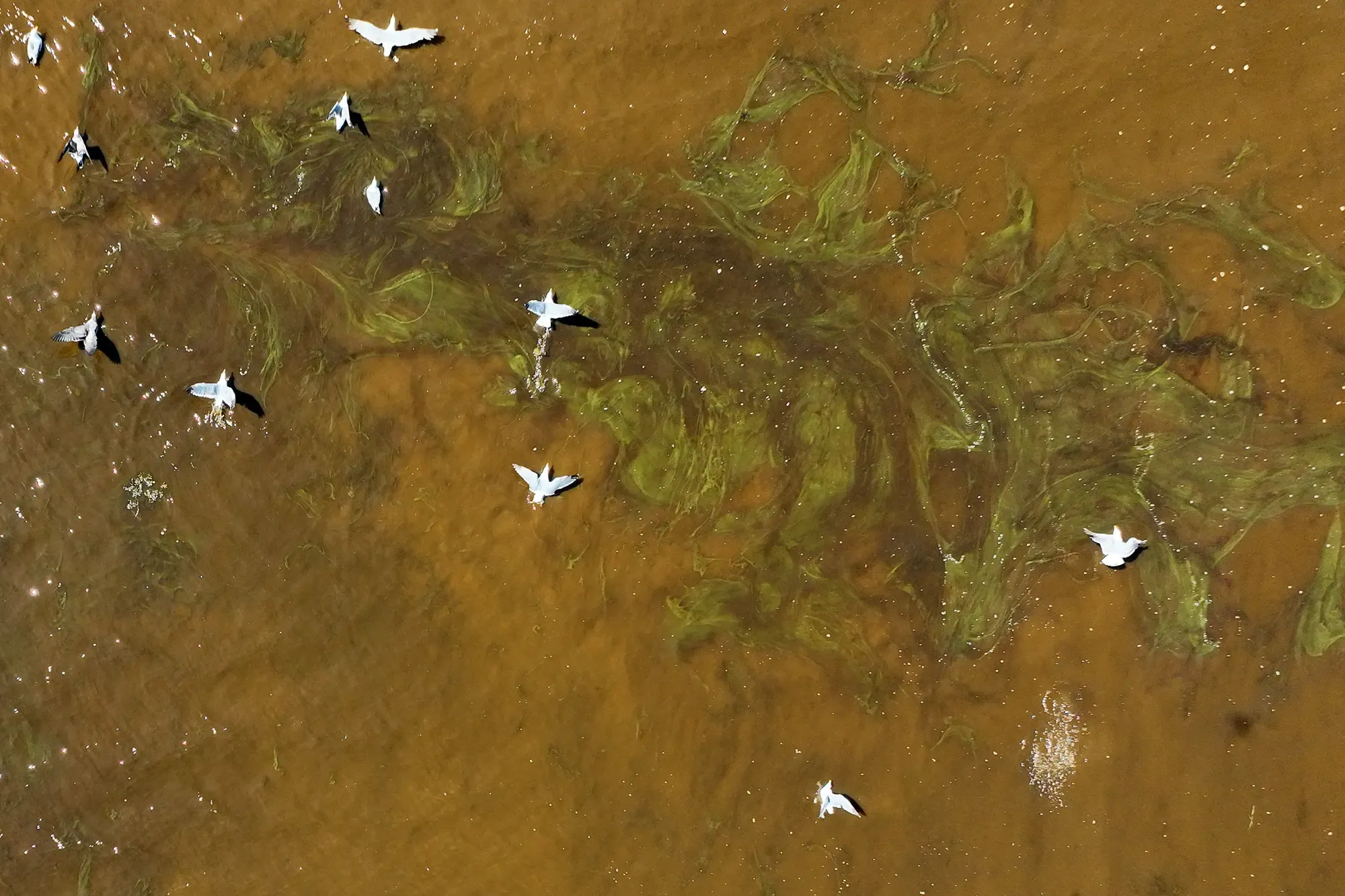
Gulls fly over a harmful algal bloom in San Francisco Bay off Berkeley. Blooms like this feed on excess nitrogen, much of it from treated wastewater, and can strip the water of oxygen and kill fish. (Justin Sullivan/Getty Images/LA Times)
Mining Fertilizer from Wastewater
Roca’s insight starts with where it intercepts the nitrogen. Inside a waste water treatment plant, there is one small stream of liquid that carries roughly 30% of the plant’s entire nitrogen load in just 1–2% of its flow. It is concentrated, already piped, and sitting inside infrastructure that exists today, at thousands of treatment plants around the world.
Roca’s system plugs into that stream. Drawing on innovation from battery science, it selectively pulls nitrogen out of the wastewater and converts it into a fertilizer product that can be sold back into agriculture. Instead of spending energy to destroy nitrogen, the plant recovers the molecules.
A few things set the approach apart:
- Simpler to run: Roca’s system doesn’t rely on the filters, membranes, or biological processes that conventional treatment depends on. Those are costly to maintain and slow to get running.
- Built for real-world wastewater: Roca has spent years making its system durable in the messy, variable conditions of actual treatment plants, not just in the lab.
- Lower energy: Recovering nitrogen this way uses significantly less energy than destroying it through conventional treatment, or than making new fertilizer from natural gas.
- Compact and modular: The system fits into existing plants without major construction and can scale up as needs grow.
- Room to grow: The same approach could eventually recover other valuable resources from wastewater, such as phosphorus and critical minerals.
At a single mid-size treatment plant, Roca projects that one system could each year:
- Keep about 189 tonnes of nitrogen from reaching the bay, roughly what a town of 40,000 people sends into the sewer.
- Produce about 400 tonnes of fertilizer, enough for around 2,800 acres of corn.
- Avoid about 3,360 tonnes of CO₂e, the equivalent of taking ~730 cars off the road.
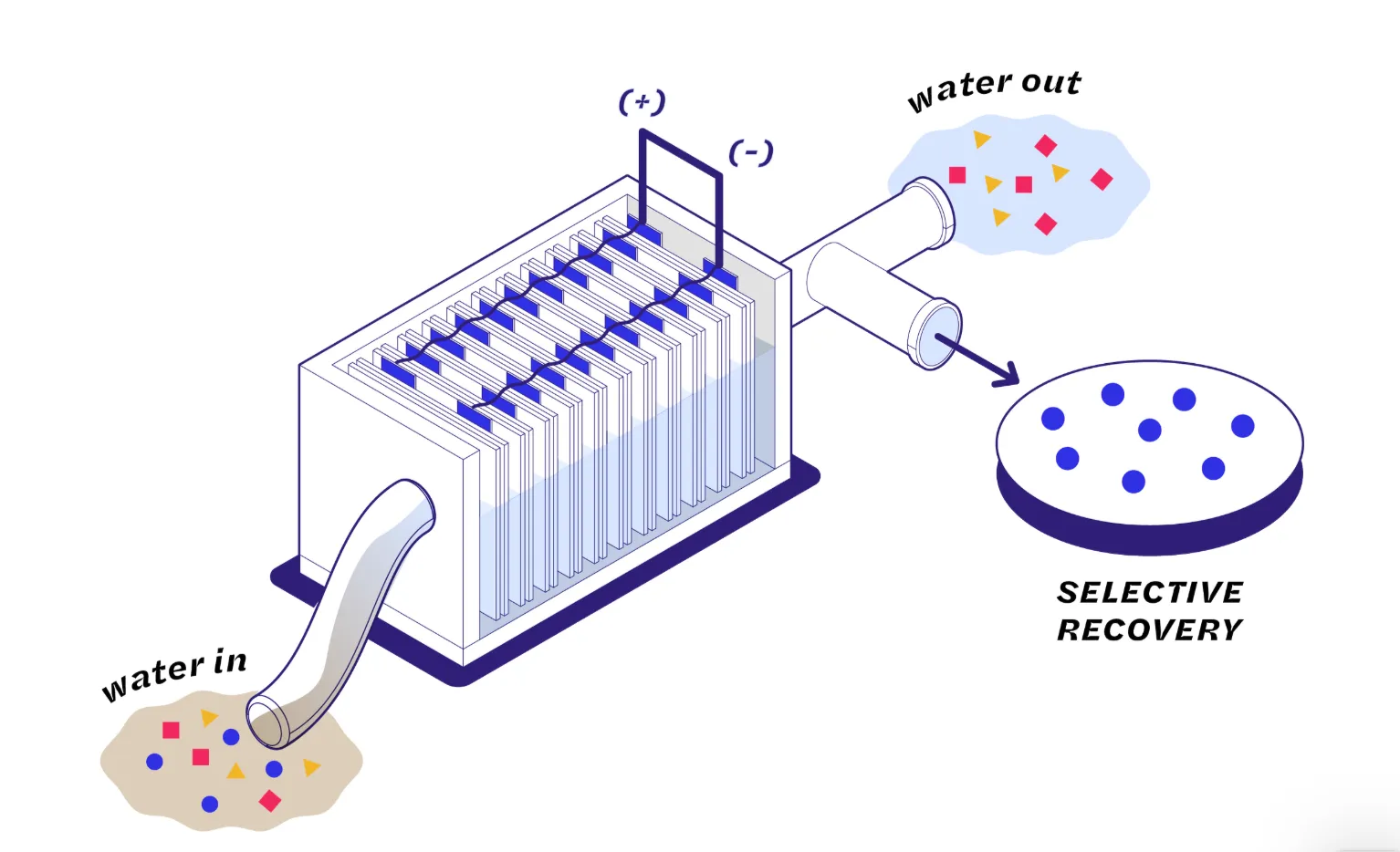
Wastewater flows into Roca’s modular system, which picks out nitrogen (blue) and leaves the rest of the water to flow on. That nitrogen is recovered and turned into fertilizer instead of being released into the ocean. (Image courtesy of Roca Water)
From the lab bench to the treatment plant
Roca was founded in 2023 by Dr. Margaret Lumley through the Activate Fellowship. In three years, the team has moved methodically from chemistry to engineering to customers:
- Conducted more than 300 customer discovery interviews with utility operators, fertilizer offtakers, and engineers.
- Validated the technology on real wastewater from municipal, dairy, and food processing facilities.
- Scaled from 4 cm² single electrodes to 25 cm² multi-stack flow cells, and extended electrode lifetime from under 20 days to more than six months.
- Won a place in ARPA-E’s RECOVER program, a $3.7M project in collaboration with Carollo Engineers, one of largest wastewater engineering firms in the U.S., and Princeton University, which began in June 2026.
- Signed letters of intent with wastewater plants to evaluate their wastewater ahead of on-site field trials planned for 2027.
The next 18 months are crucial for Roca Water. They will turn a validated bench technology into a field-proven one: finalizing pilot sites, launching a paid wastewater screening program for utilities, and building the sub-scale system that will run on-site in 2027. That is exactly the kind of early, catalytic moment where we believe a strategic investor can make a difference.
RELATED: Utilities and food processors can submit a wastewater sample for Roca to test here.
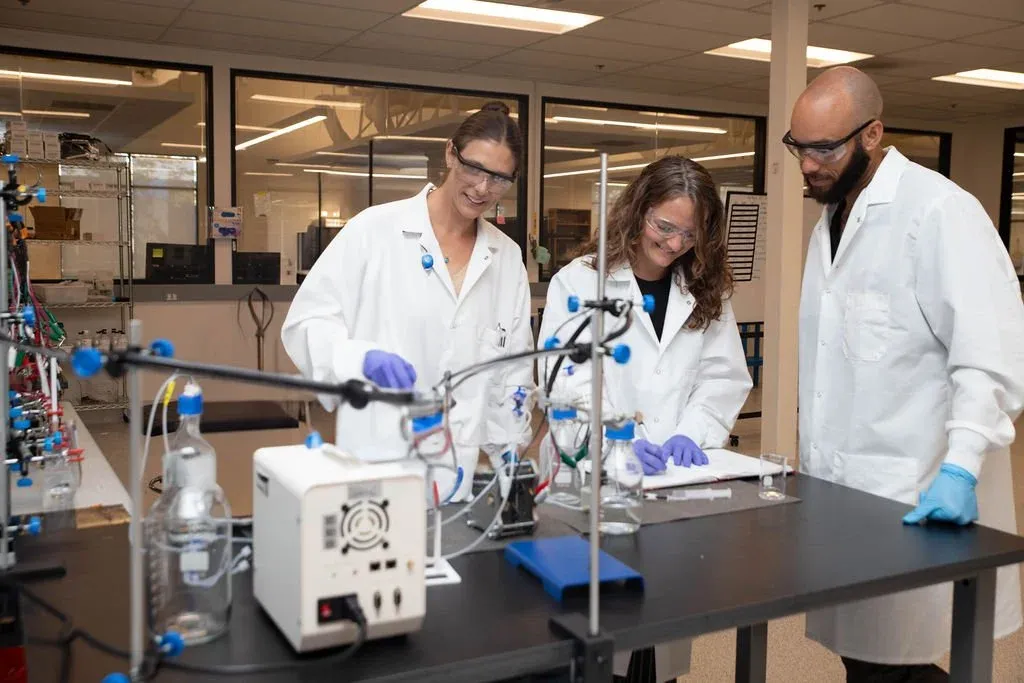
Inside Roca Water’s lab, a small, deeply technical team of chemists and engineers is turning years of research into a system ready for real treatment plants. In this picture: Margaret Lumley (Founder & CEO), Kelly Carpenter (Electrochemical Engineer), and Ethan Curling (Technology & Product Lead). (Image courtesy of Roca Water)
Why We Invested
Our decision to invest in Roca Water came down to five reasons:
1. One intervention, two benefits
Roca does not sell a product and report impact on the side. Every tonne of nitrogen it recovers is a tonne that never reaches coastal water and never has to be manufactured from natural gas. Because the recovered fertilizer replaces new production rather than adding to it, Roca also helps keep the total amount of nitrogen in circulation from growing. That is one intervention with both an ocean outcome and a climate outcome, and it scales directly with every system deployed.
2. Nitrogen removal that pays, and can therefore travel
Every other nitrogen removal option is a compliance cost. Roca generates revenue, from fertilizer offtake and service fees, on top of cutting a plant’s energy and treatment bills. That matters beyond the Bay Area. Cost-positive removal is the model that can reach the reefs, estuaries, and coastal towns where no regulator is forcing the spend today, which is where much of the ocean’s nitrogen pollution problem actually lives.
3. Genuinely differentiated technology on a platform chemistry
Most nitrogen treatment relies on filters that clog or bacteria that are slow and finicky to manage. Roca’s system needs neither, which removes the two most common points of failure. The team has also spent years making it durable enough to run in real wastewater, which is where similar approaches have historically struggled. And the same system could eventually be adapted to recover other valuable resources, like phosphorus and critical minerals, from different waste streams. Other companies are already using related approaches for lithium and magnesium, which gives us confidence the technology can scale.
4. A rigorous, deeply technical team
Margaret holds a PhD in chemistry from the University of Wisconsin–Madison, is an Activate Fellow and Forbes 30 Under 30 honoree, and is a second-time founder. Before landing on ammonium, she tested this technology against several other markets and moved on each time the economics didn’t hold, a discipline we value enormously at this stage. She is joined by Dr. Ethan Curling (PhD Chemistry, UC Berkeley), who leads materials science and product development, and Dr. Kelly Carpenter (PhD Chemical Engineering, University of Washington; formerly Google X), who leads electrochemical system design, and Rob Whitaker (Data & Software Lead, who built Roca's data infrastructure and leads machine learning and process monitoring. Advisors from Princeton University, Carollo Engineers, and the water and food industry (ex-PepsiCo and Unilever) round out a team that understands both the science and the utility customer.
5. Regulation and fertilizer markets pulling in the same direction
Two demand curves are converging. On one side, utilities are being compelled to remove nitrogen, from San Francisco Bay’s 40% reduction mandate to the EU’s recast Urban Wastewater Treatment Directive. On the other, nitrogen fertilizer prices remain volatile and import-dependent, and growers are looking for domestic, lower-carbon supply. Meanwhile, sewage nutrient discharge is projected to roughly double by 2050. Regulation guarantees the money will be spent; Roca’s job is to prove that spending it with them is the better deal.
Our vision: closing the loop between land and sea
For decades, we have treated nitrogen as waste on its way to the ocean and as a commodity on its way to the farm, two separate problems managed by two separate industries. Roca Water connects them. By intercepting nitrogen where it is most concentrated and easiest to reach, and turning it into something farmers want to buy, Roca makes protecting coral reefs, seagrass meadows, and coastal fisheries part of how the water and food systems run, rather than an added cost on top of them.
SOA is proud to back Roca Water and to welcome Margaret and the team into the Ecopreneur Network as they head into their first field trials, as part of our commitment to cleaner coasts and a circular blue economy.
If you are building or funding solutions at the intersection of robotics, ocean data and the blue economy, let’s connect. Send a message to Alicia Hernández Arriaga at alicia@soalliance.org.
By: Alicia Hernández, Investment Manager, and Matt Mulrennan, Head of Investments